

Qualified doctors place every graft, start to finish.
Consult online, then a single-day visit at our Haridwar clinic.
No hidden or surplus charges for Roorkee patients.
In-person and video follow-ups from the first month to full growth.
Beard oils, derma rollers and many beard products claim to restore beard hair, but the truth remains the same: follicles that are permanently damaged or areas with no follicles cannot produce hair. The problem is not the routine; it is the treatment approach.
For Roorkee patients, getting a professional opinion is the honest starting point. That first consultation carries most of the weight. Our doctors study how your beard currently grows, measure what your donor scalp can safely give, and design a shape that fits your jaw rather than a stock template.
The permanence of the procedure is the benefit that outweighs all other options. Follicles extracted from your own scalp fill the sparse zones and grow naturally as facial hair. You can shave them, trim them, or style them according to your preference.
QHT does not operate a centre in Roorkee. Patients from Roorkee are treated at our Haridwar branch, 31 km down NH-334. One day of travel, with a short drive. Patients arrive in the morning, complete the procedure, and are back in Roorkee the same evening. No hotel. No two-day plan.
Men who have tried many topical products usually arrive with the same realisation: years spent on several remedies and products with minimal to no changes in hair growth. Topical treatments cannot revive dormant or permanently damaged follicles. A transplant bridges this gap by replacing these follicles with new DHT-resistant follicles.
The mechanism is simple. Hair is taken from the back and sides of your scalp, where growth is dense and hormonally stable, and moved into the thin or bare zones of your beard. Those follicles establish a blood supply in the facial skin and grow as facial hair from that point on. You can shave and style them exactly like the natural beard hair. A beard transplant in Roorkee resolves the problem at its source: a bare cheek that lacked functioning follicles now contains transplanted follicles that fill the patchy and sparse areas, capable of lifelong growth, giving you a fuller beard.
Not every patchy beard needs surgery. Some beards that look patchy in early years may fill in naturally in a man’s late twenties, and a consultation with a surgeon will tell you to wait rather than book you for a procedure. When the patchy or sparse zones have stayed bare for years, waiting is no longer a sound strategy.
You are likely a candidate if one of these matches your current situation:
Whether a beard transplant is ideal for your case or not is settled by a doctor examining your growth pattern and donor supply. A patchy beard is common. Being a good candidate is a separate question, and the free online check answers it before you spend anything.
Advanced techniques are highly preferred for beard restoration, as it is the visible area of the face and even a minor error can result in repair procedures later. Two methods with advanced tools are used at QHT Clinic.
FUE allows individual extraction of follicles with a motorised micropunch. No strip, no linear scar, just small, tiny dot-like marks that fade into the donor hair as they heal. Recovery is quick because each wound is under a millimetre wide.
QHT, the patented Quick Hair Transplant technique, outperforms FUE. Finer punches are used to extract each graft, and a specialised SAVA implanter is used to place it at the precise angle and depth in a single motion. Grafts are placed simultaneously from extraction to placement, and the out-of-body time stays under 2 hours, which delivers a documented 95% graft survival rate.
A beard is not a scalp, and the difference changes the entire job. It is the most visible part that people immediately notice, so the angle and direction of each hair carry more weight than raw graft count. Concentrating more grafts on the cheek results in a doll’s hair appearance, which no amount of density corrects afterwards. Our surgeons read your existing facial hair pattern and implant the new hairs to match it, which is the actual reason a good result feels natural and long-lasting. That judgment is built across 15,000+ procedures.
QHT surgeons also preserve the donor area. Overharvesting scalp hair for a beard means compromising a future procedure to fund this one, so donor area management is one of the most important aspects of performing the procedure.
The surgery is performed under local anaesthesia, and you will be awake for all of it. At QHT, a standardised protocol is followed across all branches.

Recovery timeline is shorter with advanced techniques. However, certain events might create panic that are expected part of the journey.
The individual recovery journey may vary from patient to patient. If your results are delayed, it does not necessarily mean that the hair transplant is failing.
A good beard transplant looks completely natural, and nobody identifies it. No drawn-on edges, no visible differentiation where new hair meets old, no cheek line that stops abruptly. The beard simply looks like it was always there.
What separates a natural outcome from an obvious one is hair growth in one consistent direction, following a natural growth pattern. Density stays even across cheek, chin, and jaw with no thin zone giving it away. The upper cheek border feathers rather than following a straight line. The moustache flows into the beard without a gap.
The hair comes from a scalp region which is resistant to the hormone DHT; it grows on your face the way it grew on your head and does not thin the way a patchy beard once did.
The best result is the one nobody mentions. They will assume you finally grew it.
Not one run by QHT in Roorkee. Roorkee patients are treated at our Haridwar clinic, 31 km away on NH-334, a drive of around 45 minutes. You travel once, for the procedure day, and are home the same evening.
Chandra Rekha Tower, Chandra Rekha Lane Next to HP Jagat Petrol Pump, Delhi-Haridwar Highway, Jwalapur, Haridwar, Uttarakhand 249407
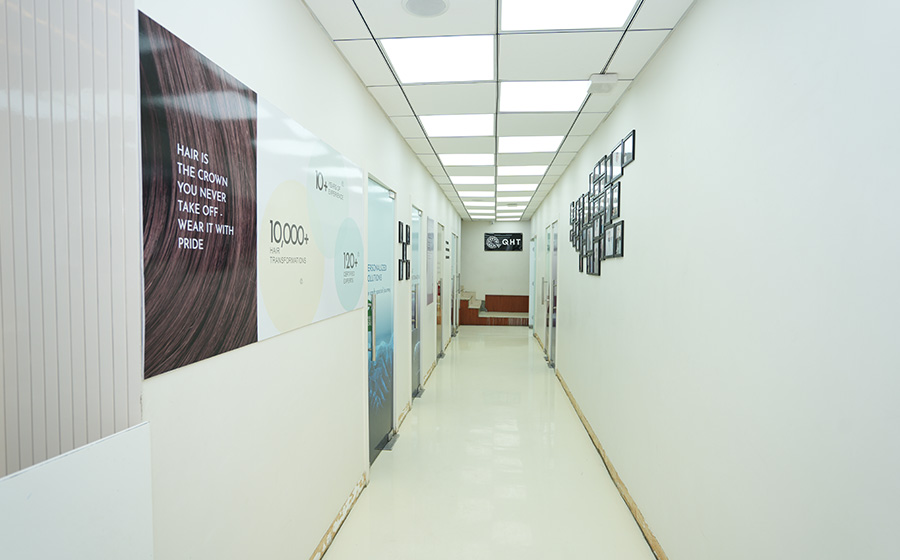
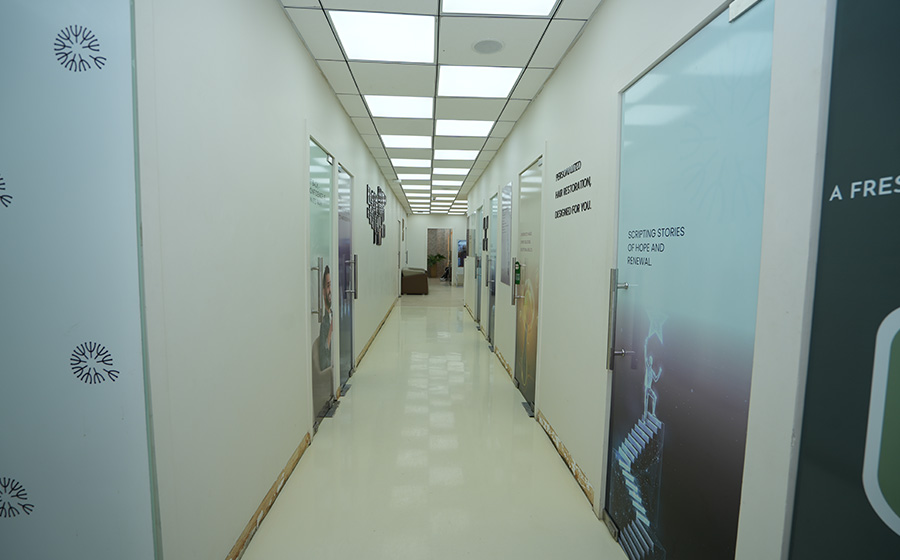
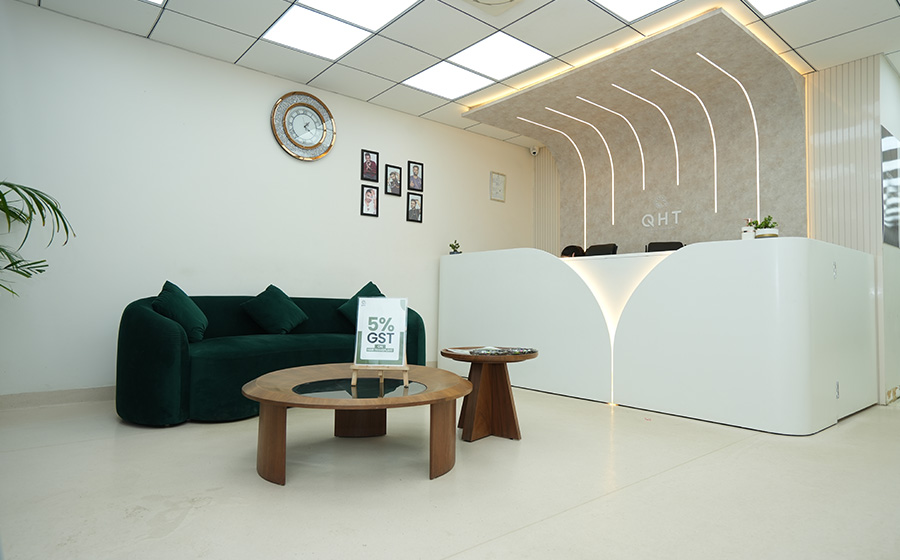
Dedicated operating theatre, strict hygiene and sterilisation protocols, and a surgeon-led team on every case.
A good beard transplant looks completely natural, and nobody identifies it. The beard simply looks like it was always there.
FUE beard transplant cost at QHT Haridwar starts from ₹70 per graft. The final cost is calculated after estimating the number of grafts required.
Two variables move the number more than anything else: how many grafts your beard needs and which technique places them. Surgeon involvement and the 12-month aftercare are included in a final package, along with anaesthesia support and preoperative investigations.
These are indicative ranges only; the final count is calculated after in-person evaluation. For Roorkee patients, the cost parameters remain the same. You pay the same per-graft rate, because the price follows your grafts, not your address.
How many grafts your beard needs is the single biggest driver of the final figure.
FUE starts from ₹70 per graft; the patented QHT method from ₹100 per graft.
Surgeon involvement is included in the final package, not billed separately.
Anaesthesia support, preoperative investigations and a full year of aftercare sit inside the package.
Beard transplant in Roorkee, answered by the doctors who perform the procedure at our Haridwar centre.
Not one run by QHT. Roorkee patients are treated at our Haridwar clinic, 31 km away on NH-334, a drive of around 45 minutes. You travel once, for the procedure day, and are home the same evening.
Yes, when a qualified surgeon performs it under sterile conditions. It is a day procedure under local anaesthesia. You are awake throughout and go home the same day. Complication rates stay low when aftercare instructions are followed.
Permanent. The hair comes from a scalp zone DHT does not affect, so once the grafts settle and grow, they continue growing on your face for life. You groom the beard like any other.
A full beard with sideburns runs 2,500 to 3,500 grafts, depending on how patchy the starting point is and how dense you want to finish. A moustache or a single gap needs considerably fewer. Your exact count comes from the clinical assessment, although an online consultation can provide an indicative estimate.
Wait 3 to 6 months before shaving the transplanted zone. Shaving early risks disturbing grafts that are still settling. Your surgeon clears you based on how your growth is coming in.
FUE leaves no linear scar. Follicles are lifted one at a time through openings under a millimetre wide, which heal to dots that disappear once the donor hair returns to normal length. There is no strip incision.
Only as a temporary cover. Keratin fibres sit on the surface for a day and wash out, and they do nothing for skin with no follicles beneath it. Dermal fillers add volume along the jaw but produce no hair. A transplant is the permanent correction because it places real, growing follicles where the gap was.
Often, yes. Revision cases involve correcting hair direction, filling low-survival zones, and softening borders that were placed too sharply. What is achievable depends on how much donor supply remains, which is assessed at consultation.